The Case for Aquinas
The Beauty and Dynamism of Thomistic Thought in Stein, Maritain, and Lonergan

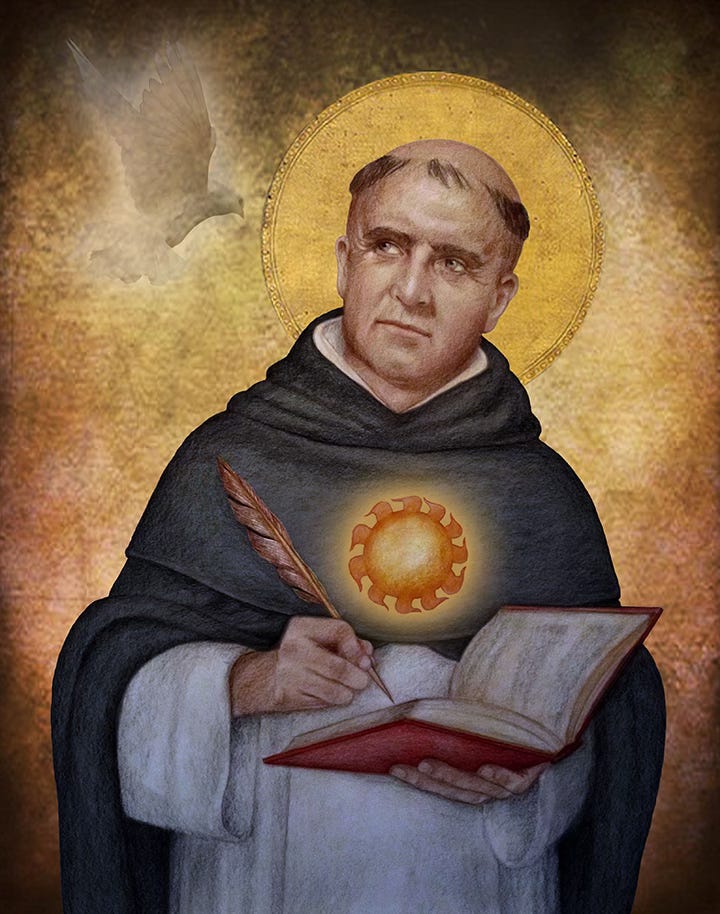
Artwork courtesy of Tracy L. Christianson www.portraitsofsaints.com
I only have two classes left in my PhD program, and then I write my dissertation on Edith Stein and Aquinas. As I come to the end of my program, one of the things that keeps amazing me over and over is the beauty and richness of the intellectual deposit of the Catholic Church. On a recent podcast, a few Catholic professors were discussing their awe and wonder about this, and one of them described it as the ‘capaciousness’ of the tradition, the room it has inside it to hold a huge amount of ideas. This is my new favorite word right after ‘magnanimous’ for describing the truth and beauty of faith in a soul or intellect. It is just so endlessly interesting and fun to contemplate the life of God and his creation of human nature. God is such a poet, and his creation is so beautiful.
No one has given us more to contemplate than St. Thomas Aquinas.
I was drawn to Aquinas through other thinkers. The first was Bernard Lonergan, and my MA program at Boston College gave me excellent guides through his work. What drew me most to his thought was what I now recognize as a Thomistic worldview; we are knowers, and reality is knowable. Through his critical realism, he showed how the dynamism of the human intellect as outlined by Aquinas allows us to reach truth, insights, and objective knowledge.
Since then, the thought of Edith Stein, W. Norris Clarke, and Jacques Maritain have all illuminated my understanding of the person. Their rich account of the soul, and of the subjective consciousness connecting with objective being is so much more satisfying then the material view of man. This view which has become known as Catholic Personalism holds that the essence of human nature is wired for relationality, connection, and to communicate themselves through art and empathy. Though each of these philosophers drew me in because they helped answer the questions I was interested in, it is amazing that the common bond they all share is the influence of Aquinas in shaping their thought.
The essay by the late great Ralph McInerny called ‘Second Hand Straw’ (which is behind academic paywalls but I quote from below) made clear the dynamic richness of Thomistic thought that influences other thinkers. But more then shaping great thinkers, the truth in Aquinas is also the remedy to so much that ails modern thought. He points to the challenge put forward by Pope Leo XIII to look to St. Thomas to reignite the truths the modern world has forgotten. This pope, who Leo XIV chose to emulate by choosing his papal name, made his case to return to Aquinas as the root of the Catholic intellectual life in his encyclical Aeterni Patris. McInerny looked about at the detritus of Catholic universities and urged us to heed Pope Leo XIII. He writes:
If I have a thesis tonight it is this. Catholic philosophy flourishes only when it is conducted in response to the Church’s reiterated directive that we take Thomas Aquinas for our principal guide. Catholic philosophy falters, and our organizations grow anemic, to the degree that Thomism becomes weak. We, our organizations and institutions, will flourish only when there is a renewed sense of the providential role that Thomas Aquinas is meant to play in the intellectual and cultural life, not only of the Church, but of mankind generally. The last thirty years and more have seen the progressive secularization of our colleges and universities. The pathology whereby Catholic and other Christian colleges transform themselves into the very thing they were founded to counter has received much attention of late. For me, it is not a possible object of research, but something I have witnessed close up. What went wrong?
He goes on to say that while many point to the antiquated language and mistrusted objective authority in the Pre-Vatican II theology and philosophy, there is no denying that for Catholic converts like Stein and Maritain, stumbling on the thought of Aquinas for these seekers of truth was hugely satisfying. He writes:
How often has one heard and read of the dreadful days before Vatican II, of all those terrible textbooks, the required courses, the insularity and jargon, the quibbles over texts, the appeals to authority. One can of course depict any movement in terms of lesser, even tertiary figures, take its failures and flaws as its aim. But of course philosophy generally, not just Catholic philosophy, can be caricatured and parodied in that way.
He then added:
Let me put before you two figures, Jacques Maritain and Edith Stein. Both were converts to Catholicism, both were educated persons at the time of their conversion, indeed, Edith Stein had a doctorate in philosophy and was one of the most promising of Edmund Husserl’s students. With conversion to Catholicism came rather quickly an intellectual transformation, manifested in a turn to the study of St. Thomas Aquinas. “It was from St. Thomas that I first learned that scholarly work could be regarded as a service to God,” Edith Stein wrote. Maritain and Stein saw in Thomas what the Church told them they would find-the means to remedy the intellectual and cultural ills of the day.”
My own great hunger that led me back to get my doctorate was the clash between my experiences as a Catholic writer, mother and academic revealing the truth and richness expressed about the human soul, and then seeing that view tied up, gagged, and bound by the culture. It seemed so many thinkers denied the transcendent in us because they needed to deny the transcendence of God. But as St. John Paul II stated so beautifully, in Teachings for an Unbelieving World, Christ reveals man to himself. When we shut out His light in our culture, we end up shutting it out in ourselves. This pain, this anemia of thought, this barrenness and the loss of what is the potential of every person, keeps drawing me to thinkers that illuminate the opposite reality.
McInerny points to these thinkers that discovered the truths Aquinas outlined about God and man, Creator and creature, which fertilized their thought and created new works of philosophy, new ideas about art and the human soul, that offer so much richness and beauty compared to the incoherent, limiting, and nihilistic ideas in our culture. He writes:
We see all around us a turning to Thomas. We see converts who have experienced from within the inadequacy and incoherence of its rivals turn to Thomism. They bear testimony to the wisdom of Leo XIII. This is a time when the great institutional expressions of Thomism have all but disappeared. But they came into being as a result of the achievements of individual students of Thomas.
I can’t help but wonder, what would this revival look like?
I hope to explore this question in my Substack posts this year, and to take individual thinkers that have been shaped by the ideas of St. Thomas and explore them. To begin, I will first look at Jacques Maritain’s poetic knowledge, which he also calls creative intuition. This is the type of knowing that human beings have first through the senses, and is pre-conceptual, and pre-rational. The powers of the soul, first outlined by Aquinas were taken up by Jacques Maritain in his works Art and Scholasticism and Creative Intuition, are responsible for the creation of art which he describes in the most beautiful way. Maritain brilliantly examines this type of knowledge and shows how our modern world completely disregards it.
When Descartes ushered in his famous cogito, ergo sum, the result was he separated the mind from the body by making truth rest on conscious rationality alone. But for Aquinas, reason was only one type of knowledge. The view of the person that existed from Aristotle up to Descartes was as a composite of body and soul. Thus, the knowledge from the body was not only legitimate, it was essential to a full view of the person.
Many people who criticize a return to Thomistic thought say modern thinkers do not even have the vocabulary to understand his concepts. But they do not say why they cannot learn his vocabulary along with his ideas, just as every Freshman in a Philosophy 101 class learns the ideas of Aristotle. To be fair, they are equally as critical of his teleological philosophy and virtue ethics, as Alasdair MacInyre points out in After Virtue, but it isn’t because it cannot be learned or understood. It is that they reject any claims to the Good or knowing the Good, and saying the concepts are too hard is an easy out.
Why, if his framework has been so fruitful for so many thinkers, shouldn’t we try? Clearly there is something in it that is a better alternative than the fragmented truth of postmodernism that, while it brings about the richness of the subjective person, banishes that same person from being able to know themselves or each other fully and transcendently.
Maritain hoped a turn to the ideas of Aquinas could be a means to rescue modernity. He urged us to draw our “attention to the utility of having recourse to the wisdom of Antiquity…at a time when the necessity of escaping the vast intellectual confusion bequeathed to us by the nineteenth century and finding once more the spiritual conditions of work which shall be honest is everywhere felt (Maritain, Art and Scholasticism, p. 4).”
Aquinas borrowed from Aristotle’s basic philosophical ideas of form and matter, potency and act. Where Aristotle developed these metaphysical ideas to try to answer the question ‘why is there change in nature?’ Aquinas borrowed them to answer questions about the nature of God, and the nature of his creation, especially the human being. A clear understanding of the human being is what is most desperately needed in our world today. To understand Aquinas’s conception of the human being let’s review these basic metaphysical ideas he used from Aristotle.
Form is the idea, blueprint, concept, essence or nature of a thing. Aristotle took Plato’s Theory of the Forms, that essences such as Beauty or Goodness exist as immaterial ideas and can be understood by the rational intelligence of human nature through concepts or universals. (The rejection of essences, or essential natures today is the rejection of objective truth). Matter is the material that form takes shape in. This happens through potency and act. Aristotle brilliantly theorized that change happens when potentiality is acted upon, such as when the potential oak tree in an acorn is activated and brought into being.
In a human being, form is the soul or essence and matter is the body. Aquinas echoed Aristotle in explaining that human nature is a composite of body and soul, and their inextricable relationship is made clear by the fact that the soul gives form and life to the body. This hylomorphic view of human nature sees man as an embodied soul. While Plato believed matter and the body were to be cast off when we die, and the soul or form could be ushered into the immaterial realm they came from, which trickled down through history as the Manichaeism heresy that Augustine fought against, promising salvation through knowledge and rejecting matter. But for Aristotle and Aquinas, substances only had being through the union of both form and matter. While Aquinas calls anything made up of matter and form a composite being or a ‘substance’, Maritain uses the term ‘subject.’
As the Christmas story just reminded us, matter and the body are instrumental to the fulfillment of human history, and this ontological unity of soul and body has many implications for how we understand the human being.
Since the Enlightenment, the modern view of man holds the Cartesian divide between the mind and the body, but this is a false dichotomy in the history of philosophy. Aquinas sees the mind as an extension of nature, and he is interested in showing how the human mind is wired to know the external reality. Through our objects of thought, objects of our appetites, desires, and will, we see we are wired to direct our inner world out there, a point which modern philosophy and psychology both have called intentionality. Lonergan and Stein both point to the ideas of intentionality (central to phenomenology and the work of Husserl) as something Aquinas was the first to understand. This directedness of our actions begins with the perception of something that appears interesting, good, something of value. This is how modern science understands consciousness operating, and it reflects a union of body - through perception - and soul - through valuing and choosing of the will.
This union of the mind with reality, where the knower and known become one, is central to Aquinas’s world view. And it is something so welcome to all those who are seekers of truth, like Jacques and Raissa Maritain, who were so bereft at the meaninglessness of French philosophy in the early 20th Century that they made a suicide pact. In one year, if their artistic and sensitive souls could not find meaning in this world, they would end their lives. Shortly after they they were exposed to Henri Bergson, who opened up the door to transcendent meaning through his view of intuition and elan vital, pointing to the dynamism of the human spirit and our ability to transcend the self. They also met Leon Bloy, whose life, friendship and writings convinced them of the truth of his view that the only tragedy in life was not to become a saint. Like Edith Stein found in Phenomenology under Husserl, they discovered an opening to transcendent truth, and also like Stein, right after they found this opening, they found Aquinas, and then the truth, beauty and goodness of being took root and blossomed in their towering intellects.
This is because for Aquinas, the soul is the root of all knowing. He saw the world and the human knowing as fitting together like puzzle pieces. In all forms of knowledge, the knower and known join to become a common principle of the act of knowing. Just like love joins two people to make a third, the Trinitarian root of the imago Dei is seen again and again in the patterns of existence in many of the writings we will examine: the generation of new life, new knowledge, new creation throughout all of of human history. In an age where intelligence is something artificially made, and ‘consciousness’ is seen as potentially transferable to AI, or another body, or a brain in a vat in the case of Lewis’s imagination, Aquinas would hold consciousness can never be separated from the soul and body, since it exists within them in the actual world.
For Aquinas, the central role the Enlightenment gave to reason and rationality to reach certainty of knowledge ends up limiting knowledge, since the reasoning process is due to the imperfections of our mind, and it is limited by its constraints. Reason, or rational knowledge, can “go no farther than the universal and no closer than the concept. Its proper truth is found in judgment; that is, it establishes a meaning by affirmation or denial, the association or separation of qualities. And all the time the mind is straining for the thing, whole and close (Thomas Gilby, Poetic Experience: An Introduction to Thomist Aesthetic, (New York: Sheed & Ward, 1934, p. 20).”
So we see at the heart of Aquinas’s view of the person, the intellect has all of being as its object, and to limit it to just concepts and logical principles is to put a fence around knowing. From Aristotle, Aquinas developed what is called the “metaphysics of cognition” which is a kind of intuition, a pre-rational, pre-conceptual act of the intellect which grasps first principles without the aid of proof by demonstration. This type of cognition is “a spontaneous, spiritual act that recognizes the immaterial reality in the immediate object (James Taylor, Poetic Knowledge).”
We will see this will become the basis for poetic knowledge in Maritain. He shows how these intuitions rely on the exterior senses of the body (taste, touch, etc.) and the inner senses Aquinas outlined, including common sense, imagination, memory, and the cognitional sense. Common sense, which synthesizes what the mind takes in through perceptions, senses, and experience, then gives images to the imagination, and the memory uses these images to reflect on and form intuitions. The cognitive or evaluative sense is our intuition that something is good or bad before we have a conception or rational cognition about it.
Aquinas’s outline of how knowledge begins in the senses, then works through the inner senses, then the intellect, also gives us a framework for understanding the nature and limits of AI. In our scientific modern age, these types of knowing through the powers of the soul - imagination, common sense, memory, and cogitative sense - are not considered knowledge. They are inclinations, and are not valuable until they can be proven with certainty. The scientific method has its place in the creation of knowledge, but we can see the sterility of AI and its limits of creation. It highlights the way the human soul is necessary for discovery and creation, and pitted against the certainty of human rationality in our post-Enlightenment age, and its product of AI, it shows how essential it is for man to know himself and his true powers of the soul.
While Maritain looks at how these inner senses, or powers of the soul as Aquinas calls them, are used in art and poetry and creativity, which we will look at in my next post, Lonergan’s major work, Insight, outlines how much these senses are used in science. In fact, Lonergan holds that there can be no insight without imagination at work, that it is the product of this power of the soul, which he shows through his amazing examples of scientific discoveries.
It is exactly this type of knowing that Maritain calls ‘poetic knowledge’ or creative intuition, that led scientists like Einstein or Newton to ‘do’ science. To ask questions based on their experiences, and to intuit how they should form their hypothesis in their experiments. As Aristotle noted, “no other kind of thought except intuition is more accurate than scientific knowledge” and he concluded that “intuition will be the originative source of scientific knowledge.” When we consider that Einstein’s theory of relativity came about because of his imagination, his ‘thought experiments’ and his reflection on the nature or essence of gravity, we can see what Aristotle means more clearly about this type of knowing. Einstein, like Aquinas, thought that human intelligence and reality fit together because the world was intelligible.
Poetic and rational knowledge work together, and this type of knowledge which Maritain refers to as ‘creative intuition’ operates in the realm of science when the mind of scientists have intuitions about the essences of things, and this intuition leads them to develop their questions and hypotheses which are delivered to reason to verify.
There was never a line dividing poetic and rational knowledge before Descartes. They were seen as working together as part of the faculties of the human being. There are countless examples of the harm caused in everything from education, to creativity and art, and most of all in man’s view of himself, in keeping his heart and soul at arms length, believing he can figure out all of his pressing existential crises with his reason.
In my Advent reading of Caryll Houselander’s book The Reed of God I came across this quote which describes so well the importance of this type of poetic knowing in our world. She describes the way the conception, growth, and birth of Jesus happened in Mary can also happen in each one of us. Like Maritain, she stated one of the main ways this happens is through our work, and channels both Aquinas and Maritain when she writes:
“The great tragedy that has resulted from modern methods of industry is that the creativeness of Advent has been left out of work. Production no longer means a man making something that he has conceived in his own heart…No man should ever make anything except in the spirit in which a woman bears a child, in the spirit in which Christ was formed in Mary’s womb, in the love with which God created the world. The integral goodness and fittingness of the work of a man’s hands or mind is sacred. He must have it in his heart to make it. His imagination must see it, and its purpose, before it exists in material. His whole life must be disciplined to gain and keep the skill to make it.”
This is the hallmark of Aquinas’s thought: that the order and beauty in the world fits with the order and beauty in the human soul. Our work is strive to create this order and beauty first in our own soul, and then in our world. As Maritain points out, echoing Houselander’s account of work, our world cries out for the “necessity of escaping the intellectual confusion” and “finding once more the spiritual conditions of work which shall be honest is everywhere felt.”
These are pretty good marching orders if we want to heal what ails us, and what ails the world. And as Pope Leo XIII pointed out, we have the surest guide in St. Thomas. Thomism is not just antiquated, stuffy theological ideas forcing us to follow the authoritative objective teachings from an archaic past. It is the vibrancy and dynamism of poets, philosophers, and scholars who find the modern explanations of the world and man deeply unsatisfying, and instead employed Aquinas to uncover this order and beauty.
A Thomistic revival is not a reactionist, conservative response to modernity where we try to turn back the clock to a more ideal time. It is dynamic, alive, and vital. It is recognizing the beauty and order of perennial truth, and helping it unfold, and find fullfilment of meaning. As I hope to show in the lives of these great thinkers inspired by St. Thomas, this work is the most meaningful work we can do with our lives.